)
2026 Agri-Tech Outlook: Robotics AI, Precision Genetics, and the new rules of Investment
The agri-food technology sector is continuing a period of recalibration that began in 2025. After years of heavy capital inflows, elevated valuations, and rapid experimentation, the focus moving through 2026 is firmly on capital efficiency, measurable farm-level impact, and deployment-ready solutions. Robotics, physical AI, and next-generation genetics are progressing from concept to field-proven applications, while investors and growers alike are demanding evidence over narrative.
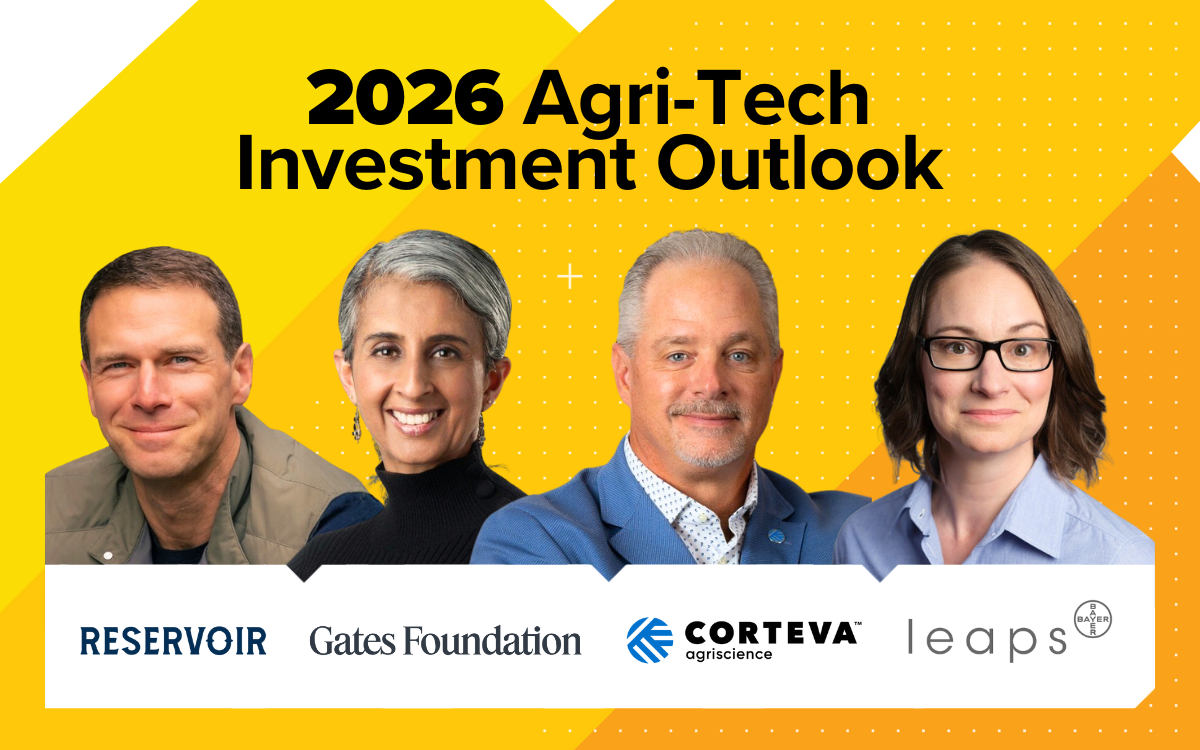
Ahead of the World Agri-Tech Innovation Summit in San Francisco, we spoke with leading investors shaping the future of agri-tech, including Danny Bernstein, CEO of Reservoir; Vipula Shukla, Senior Program Officer at the Gates Foundation; Tom Greene, Sr. Director, Global Leader Corteva Catalyst, External Innovation Investment, R&D at Corteva Agriscience; and Sara Olson, Senior Director of Venture Investments in Agriculture at Leaps by Bayer, to explore the trends driving investment in the sector this year.
The Industry Landscape: Proof over Promise
Across the agri-tech ecosystem, a common theme is emerging; novelty is no longer enough.
Investors and growers alike are prioritizing solutions that deliver predictable ROI, reduce operational risk, and fit into real-world workflows. 2025 saw companies that focused on proven performance, early field validation, and partnership-led deployment consistently outperforming those chasing breadth or untested concepts.
Danny Bernstein reflects, "The teams that made progress last year were the ones willing to prove value early, in real conditions, rather than extend pilots indefinitely."
Vipula Shukla emphasizes collaboration: "Entrepreneurial agtech businesses that partner for downstream delivery and scaling proved more resilient than those trying to go it alone."
Tom Greene highlights biologicals and gene editing: "Platforms that delivered repeatable field performance and scalable production continued to gain traction even in a choppy funding backdrop."
Farmers are operating in what Bernstein calls an “anything that lowers my costs in two years” mindset. Technologies that address labor constraints, input costs, and yield risk without adding complexity are rising to the top. Meanwhile, exit pathways remain constrained, capital is selective, and incumbents are increasingly picky about partnerships and acquisitions. Resilience is now tied to pragmatism: capital efficiency, deployment readiness, and integration into existing value chains.
Automation and Physical AI: From Experimentation to Field Reality
One of the clearest shifts heading into 2026 is the momentum behind automation and “physical AI,” particularly in specialty crops. Bernstein notes: "Ag robotics is maturing. We’re seeing companies solve very practical jobs, non-chemical weeding, smart implements, autonomy that plugs into platforms like Deere’s Operations Center. What’s not working is another standalone app or a biological solution in an already overcrowded space."
Reservoir’s farm-based incubator model reflects this shift, giving early-stage teams access to land, infrastructure, and validation so they reach pre-seed with high-functioning robots instead of just slide decks.
Shukla adds that the sector has passed “peak sensor: No producer wants to manage multiple sensor devices, each with their own operating systems, that measure only one thing. So, until and unless someone comes up with the one-ring-to-rule-them-all device, this particular category will not advance."
Biologicals, Genetics, and Crop Protection: Outcomes at scale matter
Biological and genetic innovation remains central, but the bar is higher. Greene explains:
"If a solution does not fit existing workflows, input channels, or stewardship frameworks, novelty alone will not carry it. In 2026, farmers will prioritize predictable ROI and simplicity at the edge, investors will focus on repeatability and capital efficiency, and the supply chain will reward traceable performance that maps directly to risk and quality."
Olson highlights the rise of genetic and epigenetic tools in specialty crops: "The long-awaited consumer trait revolution is beginning; from shelf-life to flavor and nutritional content, there are myriad developers working on tools and traits to make fruit and vegetable crops easier to grow and more attractive to consume."
Shukla points to next-generation crop protection as critical: "If inventors can meet expectations for efficacy, consistency, safety and low CoGS, the impact for farmers will be significant and could reinvigorate the market landscape by infusing it with new products and businesses."
AI in Agriculture: Accelerator not silver bullet
AI continues to reshape agri-tech, but investors are clear-eyed about its limitations. Shukla cautions: "AI can’t interpret or contextualize knowledge, it can’t even clean up messy data. Its value lies in accelerating well-defined processes, not replacing human judgment or field expertise."
The most compelling applications in 2026 will be AI embedded into broader systems, enhancing R&D, informing placement decisions, and supporting scalable deployment rather than standalone tools searching for a problem.
The Investment Climate: Selective, Capital-Efficient, and Partnership-Led
The funding environment remains challenging. Bernstein highlights a new class of founders:
"There’s a new class of founders bootstrapping or using public money to get to a high-functioning prototype before they ever raise pre-seed, then targeting roughly a million dollars at sub–$10 million valuations. Those companies can show 10–15 robots, multiple pilots, and real traction going into seed."
Greene notes that combining capital with capability is increasingly critical: "Corporate venture paired with co-development is accelerating time to acres and clarifying scale economics. Joint venture companies and staged collaboration agreements are aligning risk with proof by tying milestones to regulatory progress, manufacturability, and agronomic performance."
Olson underscores the importance of funding from a wide range of sources: "A founder trying to get to market or exit without taking full advantage of non-dilutive capital pools is leaving value on the table for themselves and their investors."
The road ahead: integration, evidence, and farmer trust
Looking forward, the agri-tech sector is aligning around three pillars: integration, evidence, and execution.
Automation and physical AI will continue to rewire farm operations, but only where they reduce costs and complexity. Genetic and biological innovation will be judged on repeatable performance at scale. AI will succeed as an enabler, not a standalone narrative. And founders will need to build with partnerships, not exits, as their primary strategy.
As Olson advises, fundraising decisions made in the next 18 months will shape outcomes well into 2028 and beyond. Founders who combine scientific depth with operational realism and who leverage non-dilutive capital intelligently will be best positioned to navigate the cycle.
The bar is undeniably higher. But as this group of investors makes clear, that’s a sign of a healthier, more grounded agri-tech ecosystem.
Join the Conversation
These trends will be front and center at World Agri-Tech Innovation Summit San Francisco, bringing together investors, corporates, and innovators to explore productivity, resilience, and sustainable growth. Engage with global leaders and gain insights into the technologies, business models, and partnerships shaping agri-tech in 2026 and beyond.
)
)
)
)
)
)
)
)
)