)
The Practical Innovator: Niqo Robotics’ Mission To Transform Global Agriculture
Jaisimha Rao founded Niqo Robotics in 2015 – evolving from deep-tech research and development in southern India to a commercial robotics platform company backed by $21 million from top investors.
Here Rao shares how on-farm robotics is evolving and how we can accelerate the adoption of the technology to overcome challenges presented by increasing labor shortages.
Niqo Robotics has steadily emerged as one of the most recognised names in agricultural robotics. How would you describe the journey so far and what guiding principles have shaped it?
The journey of Niqo Robotics has been shaped by curiosity, conviction, and a deep respect for the realities of farming. I began my career in the financial sector before moving into agriculture, where I saw first-hand that farmers did not need more data, they needed tangible solutions that worked on the ground. That realisation set us on a path from drone-based analytics to robotics.
Our guiding principles have always been simple. Every innovation must create real value for farmers, not just demonstrate what is technologically possible. We design for accessibility, making sure the tools we build are easy to adopt. Sustainability remains at the core of everything we do, because precision and environmental responsibility go hand in hand. And most importantly, we accept that progress in agriculture takes patience. Each growing season teaches us something new, and that learning cycle has kept us humble and persistent.
What does the recognition at FIRA World Ag Robotics Forum signify for Niqo and for you personally as a founder?
The recognition at FIRA is a powerful validation of the vision we have been building towards for several years. For Niqo, it affirms that our technology and business model have matured to a point where they can compete globally. For me personally, it is deeply gratifying to see an idea that began in Indian farmlands being acknowledged on an international stage.
It also carries a sense of responsibility. Recognition creates higher expectations, and we now have the opportunity to set new benchmarks for performance, reliability, and impact. What matters most is not the award itself, but how we build on it to deliver lasting value for growers across markets.
Agricultural robotics is often seen as a slow-moving industry. What breakthroughs or mindset shifts do you think are finally accelerating adoption?
Agriculture is a tough space for technology to move fast. It’s seasonal, unpredictable, and every decision affects a farmer’s ROI. But over the last few years, we’ve seen a real shift. Labour shortages and rising input costs have made automation essential, not optional.
The focus now is on solving real problems in the field. We’re not treating robotics as shiny tech anymore, but as practical farm equipment that needs to prove its value. With better vision systems and AI, one smart robot can now handle thinning, weeding, and beneficial spraying in a single pass reliably and efficiently. That’s what’s finally driving adoption.
Niqo recently introduced a new precision weeding robot at FIRA. How does this innovation redefine efficiency and sustainability for growers?
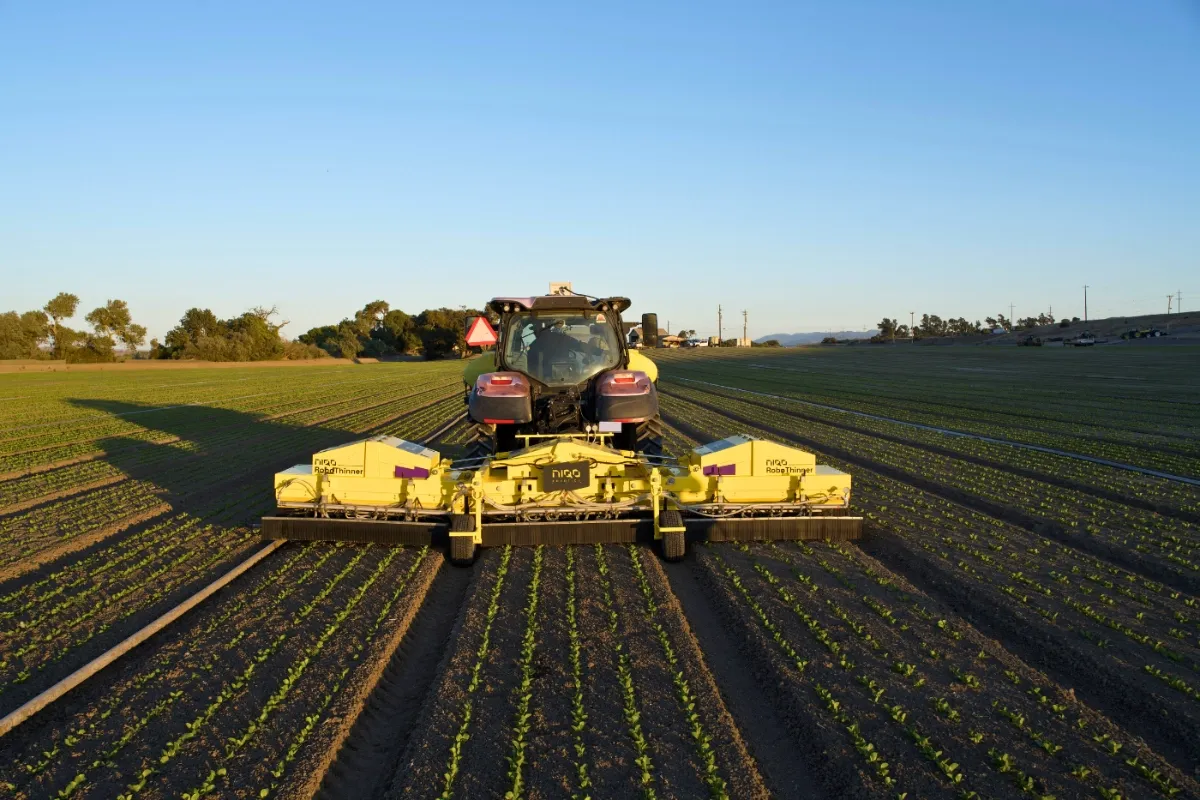
Our AI robot- Niqo RoboThinner was built around a simple idea: help specialty crop growers do more in a single pass. It combines thinning, weeding, and beneficial spraying into one intelligent operation. Powered by our Niqo Sense vision stack, it makes real-time plant-level decisions with millimetre precision, adapting to different bed sizes, crop types, and field conditions.
For growers, this means faster operations, up to 4.5 miles per hour, with measurable gains in efficiency, cost savings, and yield consistency. The system delivers a full return on investment in under two seasons, which is critical when margins are tight and labour is scarce.
It is also about reliability. RoboThinner is designed and manufactured in the United States, built to fit seamlessly into existing tractor setups, and requires no cloud connection or recurring fees. For us, this is not about adding more technology but about redefining farm equipment to solve real challenges in timing, cost, and precision.
How do you see robotics addressing the labour and cost challenges that farmers, particularly in the US specialty crops segment, are facing today?
In the US specialty crops segment, growers face intense pressure from rising labour costs, shrinking workforces, and narrow operational windows. Robotics directly addresses all three. By automating repetitive and time-sensitive tasks such as weeding or spraying, farmers can focus human labour on skilled, high-value activities.
The machines also bring predictability. Tasks that were once dependent on manual labour can now be planned and executed precisely when needed, protecting yields and improving quality. Over time, the cost per acre comes down because farms need fewer passes, fewer inputs, and less labour to maintain the same output. Robotics, in this sense, does not replace people but allows farms to thrive even when labour is scarce.
As Niqo expands across North America, what are your key learnings from working with growers in these markets and how are they influencing your product roadmap?
Working with growers in North America has been an important learning experience. The expectations are different, the field conditions are more diverse, and the tolerance for downtime is much lower. Farmers here expect machines to work continuously, season after season, with robust support. That has influenced how we design for reliability and serviceability.
We have also adapted our business model. In India, our robotics-as-a-service approach made sense for smallholder farmers. In North America, growers often prefer to purchase outright if they see clear return on investment, so our roadmap now accommodates both models.
Perhaps the most valuable lesson has been understanding how different crops demand different levels of precision and integration. This has pushed us to make our systems modular and easily configurable. Our focus going forward is to make Niqo robots fit seamlessly into the existing workflow of any grower, regardless of crop or geography.
From your perspective, what will define success for agricultural robotics companies over the next five years?
Success in agricultural robotics will not be measured by prototypes or pilot deployments but by scale and reliability. The real winners will be those who can demonstrate consistent performance across seasons, crops, and geographies. Financial viability will be equally important. Farmers must see clear economic benefit, both in cost savings and yield outcomes.
Another defining factor will be sustainability. As agriculture transitions to a lower-input future, robotics companies that help reduce chemical use, save water, and improve soil health will have an edge. Lastly, collaboration will matter. This industry will move faster if technology providers, OEMs, and farmers work together instead of in silos.
How do you maintain balance between technological ambition and the practical needs of growers on the ground?
The balance begins with listening. Every feature we design goes through a simple test: does it make a farmer’s life easier or harder? If it adds complexity without clear value, it does not make it into the product. We also deploy early and often, because real-world feedback from farms is more valuable than months of lab testing.
I believe simplicity is a form of sophistication. The most advanced machines are the ones that anyone can use, repair, and trust. That philosophy keeps our ambition grounded in the real world. We can push the limits of AI and robotics while still ensuring that the outcome is practical, affordable, and reliable.
Looking ahead, what excites you most about the future of Niqo Robotics and the role it will play in shaping global agriculture?
What excites me most is the possibility of making precision farming accessible to every grower, not just the largest ones. If robotics can democratise access to efficiency, safety, and sustainability, that would be a true transformation.
I also see Niqo becoming a global platform for crop intelligence, where every robot deployed adds to a growing network of insights about soil, weeds, and plant health. This collective intelligence can help farmers make better decisions and help the planet by reducing waste.
The future of agriculture will be defined by how well we combine intelligence with empathy for the land. That is the balance Niqo aims to strike, and that is what keeps me excited about what lies ahead.
Explore on-farm robotics at World Agri-Tech
Niqo Robotics are a silver partner of World Agri-Tech San Francisco. Join them and more than 1700 senior executives from across the agri-food value chain – from robotics and OEMs to growers and food & beverage brands.
)
)
)
)
)
)
)
)
)
)
)