)
From hype to physical intelligence: How AI, robotics, and biotechnology are reshaping agriculture
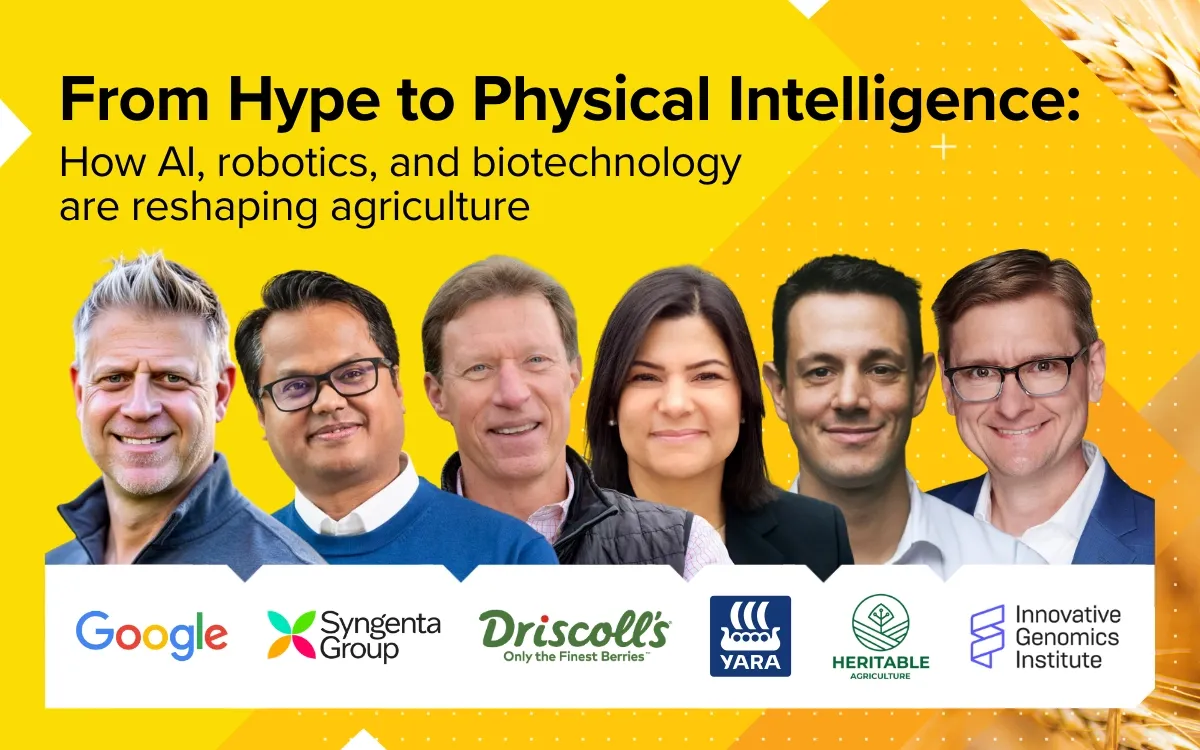
As the global AI conversation shifts from experimentation to execution, agriculture is entering a defining new chapter. Ahead of the World Agri-Tech Innovation Summit in San Francisco, leaders from Google, Syngenta, Yara, Driscoll’s, Heritable Agriculture, and the Innovative Genomics Institute shared how artificial intelligence is moving beyond digital abstraction into the physical world, fundamentally reshaping biological discovery, on-farm operations, and the future of food systems.
This emerging era is increasingly defined by agentic and physical AI: systems that do not just analyze or recommend, but perceive, reason, and act often autonomously in complex and real-world environments.
Where are we on the AI hype curve?
Across speakers, one message was consistent: agriculture is moving past inflated expectations but remains early in true transformation.
“We’re seeing a shift from over-hyped chatbots to Physical AI, intelligence actualized in the real world,” says Brian Crook, Head of Cloud AI Solution Architecture at Google. In agriculture, that shift demands hybrid systems where cloud platforms handle large-scale reasoning while inference runs at the edge, directly on machines operating in the field.
This transition is already delivering measurable results. In 2025, John Deere’s See & Spray system covered more than five million acres, achieving verified herbicide reductions of 50% - 60%. “That’s a massive economic unlock that puts money directly back into the farmer’s pocket,” Crook notes.
Still, others urge caution. Feroz Sheikh, CIO and CDO at Syngenta Group, emphasizes that much of today’s AI adoption is incremental rather than transformational. “We’re seeing a proliferation of large language models that convert existing analytics into natural language,” he explains. While valuable, particularly for smallholder farmers with limited access to expert agronomists, these tools do not yet represent foundational breakthroughs.
Similarly, Brad Zamft, CEO and Co-Founder of Heritable Agriculture, describes agriculture as “at the very tip of the iceberg” for AI adoption. Measurement, sensing, and human-support systems are already here, but more complex autonomy, especially delicate physical manipulation, remains further out.
Biotechnology: From discovery by luck to discovery by design
Nowhere is AI’s long-term potential clearer than in agricultural biotechnology, though timelines remain uneven.
“AI is shifting the industry from discovery by luck to discovery by design,” says Crook. Tools like AlphaFold and AI-guided genetic platforms are compressing R&D cycles from 15 years to under 10, effectively doubling the patent-protected revenue window for new innovations.
At Syngenta, AI is already embedded across the entire research pipeline. Sheikh points to its role in identifying new traits that help crops withstand biotic and abiotic stress, diagnose issues earlier, and reduce environmental impact. “Even a 10% reduction in R&D time or cost is tremendous economic value,” he notes.
For Scott Komar, Senior Vice President of Global R&D at Driscoll’s, AI is accelerating genetic gain across all 20 berry breeding programs. By interpreting complex trait interactions, AI supports Driscoll’s More Berries, Less Resources initiative, enabling steady progress on climate resilience across continents.
Heritable Agriculture offers a more granular view of AI’s role across genetics. Zamft outlines three layers of impact: genome-level product placement and breeding optimization already cutting field trial timelines by up to 50%; gene-level discovery identifying causative traits; and longer-term base-pair editing that could enable fully custom-designed crops. “Near-term value is real and accelerating,” he says. “Generative genomics is coming, but it will take time.”
Researchers echo this caution. Brad Ringeisen of the Innovative Genomics Institute notes that agriculture remains far earlier on the AI curve than biomedicine. “We need more diverse crop genomes sequenced and better phenotype data,” he explains. “AI can only be as powerful as the data feeding it.”
Robotics: Intelligence moves into the field
If biotechnology represents AI’s long game, robotics is where physical intelligence is beginning to materialize today.
Google’s Crook points to a new wave of Robotic Foundation Models being developed by companies like Physical Intelligence, Figure, and Google’s Gemini Robotics. These generalist AI systems allow machines to operate in unstructured environments without being hard coded for every scenario, navigating mud, variable light, and unpredictable crops.
Syngenta is already deploying robotics in trial fields and greenhouses, where machines can observe what tractors and drones cannot, under leaves and beneath dense canopies. “This unlocks entirely new agronomic insights,” Sheikh says, though he stresses that widespread adoption will take time.
At Yara, Rejane Souza, SVP of Global Innovation, sees robotics reaching commercial reliability in targeted operations. Autonomous spreaders and sprayers are not only improving precision but also generating high-quality datasets that feed back into AI-driven nutrition models. “This is the transition from experimentation to scalable, field-ready AI,” she explains.
Still, speakers agree that while robotics adoption is accelerating, true autonomy, especially across specialty crops, remains a longer-term bet.
Near-term impact vs long-term transformation
Across domains, the contrast between immediate gains and future potential is stark.
“In the near term, AI is already delivering tangible economic value,” says Crook. “We’re seeing input savings of $20–30 per acre from precision robotics, profit increases of 26% and pesticide reductions of 38% in AI-enabled pest management pilots in India, alongside faster breeding cycles and more precise product placement.”
Long-term, the ambition grows exponentially. Crook describes the development of world models capable of simulating the biosphere itself. Google’s WeatherNext 2.0 can now run a global 15-day forecast in under 60 seconds, enabling supply chains to price climate risk with unprecedented precision.
In genetics, long-term AI models could enable crops custom-tailored to specific environments, management practices, and climate futures but only once regulatory, societal, and data challenges are resolved.
Investment, infrastructure and the intelligence layer
While innovation is surging, investment is still selective.
“There is a lot of hype-based investment and bloated valuations we need to be careful about,” warns Syngenta’s Sheikh. The real winners, he argues, will be ideas that fundamentally change how farmers and researchers work, not simply digitize existing workflows.
VC investment in agriculture has declined sharply over the past three years, according to Zamft, even as AI funding surges elsewhere. This has pushed many startups to reframe themselves as “AI-first,” sometimes without the data access required for success.
Crook argues that the solution lies in shared infrastructure. He envisions an “Android for Agriculture”, a horizontal intelligence layer where Big Tech provides foundational AI stacks, simulation engines, and security, while agribusinesses focus capital on proprietary agronomic value.
Yara’s Souza agrees, predicting a shift from isolated products toward integrated, data-driven systems, where soil science, biology, digital agronomy, and robotics converge to deliver measurable outcomes.
Navigating the agentic age of agriculture
Agriculture is entering the agentic age with cautious optimism. AI is already reducing costs, accelerating discovery, and improving precision, yet its most transformative potential is still unfolding. Real-world data, grounded deployment, and collaboration across technology providers, researchers, and farmers will be essential to cut through the hype. The future of agricultural intelligence will be shaped by ecosystems that can turn algorithms into impact and intelligence into resilience.
We look forward to continuing the conversation and exploring these opportunities at the upcoming World Agri-Tech Innovation Summit on March 17-18.
For even a deeper dive, add the AI in Agriculture Forum to your ticket on March 16 for a half day packed with case studies, discussions and benchmarking workshop.
)
)
)
)
)
)
)
)
)
)
)